Salmon Futures Project
How will salmon persevere in the future? How will the changing salmon environment change the human-salmon relationship? What technologies or approaches are appropriate and equitable for conserving salmon in the Anthropocene?
Salmon are at the heart of the FishPeoplePlace fisheries research. We view salmon and the human relationship with salmon through a social-ecological systems lens, where humans and salmon have a multi-faceted relationship that spans across scales, both spatial and temporal. In this we ask a wide variety of social science questions that are embedded in an interdisciplinary understanding of ecological and social dimensions.
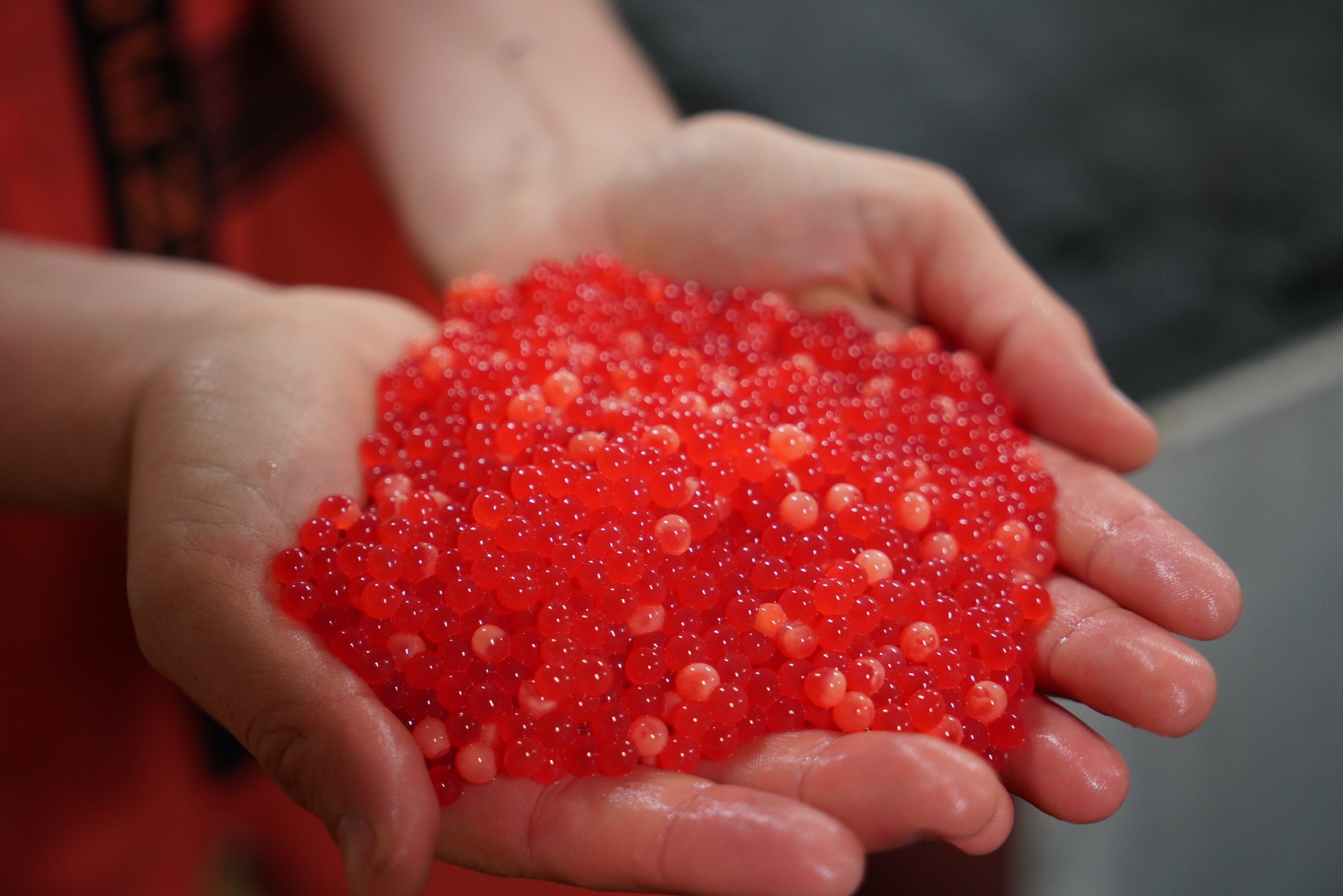
A major theme we consider in this project is how human technologies should (or should not) contribute to the conservation of threatened salmon populations. Specifically, we are interested in the contentious use of cultivation technologies - particularly hatcheries and stocking programs - for the use of fisheries enhancement and population conservation.
Why understand the human dimensions of salmon hatcheries and stocking?
Hatcheries and stocking are a, to say the least, contentious approach to salmon enhancement, conservation, and restoration in both the Pacific and Atlantic basins. Yet cultivation programs, including techniques ranging from traditional hatcheries to in-stream cultivation or smolt-to-adult supplementation, remain an important aspect of fisheries management across the salmon range. Why is this? What value do these programs serve to the federal, provincial, state, and Indigenous groups that use cultivation practices to meet their objectives? What role do these approaches play in maintaining the human-salmon relationship?
While much effort has been made within the natural sciences to explore the impacts of cultivation programs on ‘wild’ fish populations and their ecologies, less is known about their social aspects and the role they play in the communities that often surround them.
Our work is interested in understanding the multi-faceted social side of the social-ecological systems that revolve around, and include, hatchery and stocking programs. As hatcheries and stocking are sometimes considered the ‘third rail’ (meaning, contentious issue!) in fisheries management, we draw from a wide breadth of theory and disciplines to understand their role, including conflict studies, political and human ecology, fisheries management, etc.

Tilling Wild Waters
Started in 2023 and concluding in 2027, this work investigated social perceptions toward community-engaged hatchery and stocking programs for salmon in both the Atlantic Basin and along North America’s Pacific Rim. This work was led by student researchers, Eliza Preston, Katherine Dalby and Michael Fabiano (read more at People) and engages with community, conservation, management, and Indigenous groups across this area.
Thus far, this work has contributed to:
Advanced Understanding & Research of Enhancement
Using case studies, the project allowed for improved empirical study of why and how hatchery and stocking programs are (or are not) being used to pursue salmon conservation and foster human-salmon relationships. This work is anticipated to result in 4-5 peer-reviewed papers as well as newly formed and strengthened relationships between the FPP research team and our community partners to this work.
Development of Knowledge & Information Sharing
In collaboration with Indigenous groups, hatchery practitioners, government agencies, and researchers, this project provides an opportunity to address knowledge gaps in policy coordination and support peer-to-peer learning for hatchery and stocking use.
Enriched Public Discourse & Enhanced Policy Input
Project outputs will work to increase public awareness and knowledge of current practices of salmon hatchery and stocking programs in the Maritimes. Human dimensions data will be used to develop key policy recommendations to inform decision-making for future wild Atlantic salmon stocking.
This project was made possible through collaboration and partnership with:
Fort Folly First Nation
Abegweit First Nation
Fisheries and Oceans Canada (DFO)
Parks Canada - Fundy National Park
Nova Scotia Department of Fisheries and Aquaculture
Dalhousie University
We are grateful for funding from the Social Sciences and Humanities Research Council of Canada, the Freshwater Fisheries Research Cooperative (Nova Scotia), DFO’ Salmon Enhancement Program, Genome Atlantic, and Dalhousie University.

Upcoming Projects